
Aftermath: Firefighter Smoke Exposure and Completing the Save
November 9, 2026
Firefighter smoke inhalation treatment starts with recognizing that someone needs care, even when that firefighter finishes the call and says nothing.
You are riding back after a fire when you realize your head is thumping. Maybe your stomach feels off, or you feel a little lightheaded. You don’t mention it to anybody. You tell yourself you worked hard, got too hot, or need some water. By the time you get back to quarters, clean up, and start house chores or catch another run, you have already pushed how you felt to the back of your mind.
How many times have you had that conversation with yourself? How many fires have ended with you feeling lousy, keeping it to yourself, and waiting for it to pass?
You finished the assignment and helped get the company back in service. As far as everyone else knew, you were fine.
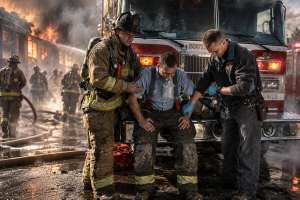
Firefighter Smoke Inhalation Treatment: What Aftermath Teaches
Just because you did not go down or receive treatment does not mean you did not suffer a fire smoke exposure.
Over a career, those exposures can become so familiar that we stop giving them much thought. Think back to the room-and-contents fire where you came off air and stayed inside to finish opening up, or the car fire where you never put your facepiece on. You got the work done, helped pick up, and went back to quarters. Maybe your head hurt or you felt sick afterward, but nobody went to the hospital, so you never counted it as anything more than another fire.
Now think about how many times that has happened since you first climbed on the rig. Not every exposure was the same, and not every one left you feeling bad. But the calls where you kept working and said nothing belong in your exposure history, too. The exposures that never put you on the ground still count.
That is why we need to look beyond how we got through the last call. Feeling better later can make it easy to forget what happened, especially when the next run comes in. Over years of doing the job, we can become so accustomed to working through how we feel that we stop considering what we have been exposed to.
Our previous Toxic Twins article introduced carbon monoxide and hydrogen cyanide and what they can do together. Aftermath takes that conversation to the next step: understanding firefighter smoke inhalation treatment and making sure care is ready when one of our own needs it.
Fireground Rehab: Speak Up Before You Get Back on the Rig
That headache may not have started on the ride back. You may have noticed it while picking up, changing cylinders, or sitting in rehab and decided it was nothing worth mentioning.
Rehab is a place to catch that before you leave the scene. It is more than getting water, cooling down, and waiting to go back to work. Medical monitoring and evaluation are part of the rehabilitation process addressed in NFPA 1584, now consolidated into NFPA 1580. [firefighte…safety.org]
Tell the medical crew how you actually feel, not just that you are ready to get back to your company. If your head is pounding, your stomach is turning, or you feel lightheaded, say so. You do not have to know what caused it before asking to be checked, and you should not wait to reach rehab if you need help sooner.
Heat, hard work, and dehydration may be part of the picture. They should not become the answer before anyone has assessed you.
It Is Not “Just Smoke Inhalation”
Aftermath challenges those three words because they make a serious illness sound like something we should be able to shake off.
The program explains how the Toxic Twins interfere with the body’s oxygen supply and use. It then connects that damage to the care a smoke-inhalation patient may need. The point is not to match a headache to one gas and nausea to another. It is to understand why the medical response must consider CO and HCN together.
Not every exposure calls for aggressive treatment. Aftermath says that plainly. But assuming someone needs no care because they are still walking and talking is not the same as checking them out.
What Aftermath Teaches About Smoke Inhalation Treatment
Watch Aftermath: smoke inhalation and treatment
Aftermath follows the patient from removal out of the smoke through assessment, airway and breathing support, oxygen, care for other injuries, and transport. It also discusses antidotal treatment for suspected cyanide poisoning.
The program features hydroxocobalamin, marketed as CYANOKIT, which is indicated for known or suspected cyanide poisoning. It is given alongside appropriate supportive care, not in place of it. The current prescribing information provides the treatment indications, precautions, and administration details.
The video also explains why the choice of cyanide antidote matters when carbon monoxide is involved. For the firefighter watching, that raises a practical question: If someone on your company needs that care, how does it get to them?
Watch Aftermath with your EMS crew and medical director, then pull out your medical SOG for smoke inhalation. Does it address the Toxic Twins? Who can begin treatment? Where are the necessary resources, and how do they reach the fireground? Have your medical director connect the program’s lessons with current treatment guidance and your department’s medical SOG.
Settle those questions at the table, not while a firefighter is waiting for care.
The right drug, for the right patient, at the right time starts with someone knowing you do not feel right.
Getting Them Out Is Not the End
We train to find a missing firefighter, get air to them, and bring them out. We practice difficult removals because we know how much depends on getting those skills right.
Aftermath asks whether we have given the medical care outside the same attention as the rescue inside. Without a smoke-inhalation medical SOG, are we prepared to complete the save?
If a firefighter comes through that doorway unconscious, the medical response cannot be something we figure out after the removal. The people, equipment, and medical SOG need to be ready for the firefighter we have worked so hard to reach.
Speakers in the program describe firefighters who survived critical smoke-inhalation emergencies and returned to work after receiving resuscitation and antidotal treatment. They also describe patients who did not survive. Those accounts are not a promise, but they give us a reason to examine whether our departments are ready to provide the care discussed.
That responsibility continues through the hospital handoff. Was the firefighter using air? What happened during the exposure? How did their condition change, and what treatment did they receive? Those details need to go with the firefighter. If they cannot tell the story, someone else has to.
Bring Aftermath to Your Crew
Put Aftermath on at the firehouse and give the treatment discussion the same attention you give the rescue. Bring in your EMS crew and medical director so the conversation connects to your medical SOG and the care available on your fireground.
Talk about the firefighter brought out by the crew, but do not leave out the one sitting quietly in rehab, feeling sick and saying nothing. We need to be ready for the obvious emergency without overlooking the firefighter who has decided to keep working through it.
We cannot change the exposures we have already had. We can change what we accept at the next fire, what we tell the medical crew, and how ready our department is to respond.
Watch Aftermath, review your medical SOG, and make sure getting a firefighter out is followed by the care needed to complete the save.
Find more crew-training material in the Kitchen Table Resource Center.

Sources