
Firefighters Cannot Wait 150 Years for Air Standpipes: The Municipal Liability Series
July 9, 2026
After a devastating theater fire in 1903, it took more than 150 years to mandate water standpipes in buildings — and firefighters cannot afford to wait that long for air standpipes. This municipal liability series from the Firefighter Air Coalition examines the legal case for the Firefighter Air Replenishment System (FARS), a code-compliant air standpipe that delivers breathable air to the fire floor through a dedicated in-building network. The built environment has entered a new era, an era of large-footprint mid-rises, million-square-foot distribution centers, data centers, fulfillment warehouses, and high-rise towers going up at a pace no one predicted. In cities, where land has all but disappeared, buildings are scaling relentlessly upward with forty-story residential towers reshaping skylines that topped out at ten a generation ago. In rural corridors, where land is still available, millions of square feet are being consumed by big-box logistics and data centers, horizontal giants every bit as difficult to search, vent, and defend as any downtown high-rise. Every one of these structures presents the same operational problem. Firefighters can and do carry additional air cylinders to the fire floor through what the fire service has long called bottle brigades, a method where personnel are pulled away from the fire attack to haul bottles up stairwells. But the bottle brigade consumes time and depletes manpower at the very moment both are scarcest. Without a continuous supply of breathable air built directly into the structure, the interior attack can be compromised long before the bottle brigade can sustain it. The technology to solve this problem exists. It is called an air standpipe, a dedicated network of piping and fill stations that delivers breathable air to the fire floor on the same simple principle as the water standpipe every firefighter already trusts.
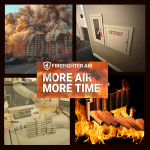
Article 1: A Duty That Cannot Be Delegated
The first article in the series establishes the foundation: municipalities bear a legal duty to protect the firefighters who enter the buildings they approve, and that duty cannot be offloaded to developers, architects, or code consultants. A city council that approves a forty-story tower or a million-square-foot distribution center is making a life-safety decision, whether it acknowledges that or not, and the permit counter is the intervention point. Once the building is up and occupied, the window for requiring air standpipe infrastructure at a manageable cost has closed. Anderson walks through the legal framework: the duty exists, it belongs to the municipality, and pretending otherwise is not a defense. It never was.
Article 2: The Duty to Foresee and Air Standpipes in the Built Environment
The second article examines foreseeability, the legal doctrine that is the cornerstone of every negligence claim. If a harm is foreseeable, those with the authority to prevent it bear a duty to act. The article documents the operational realities: high-rise fires where crews exhausted their air before reaching the fire floor, big-box fires where the horizontal footprint made interior operations unsustainable even with bottle brigades running, and line-of-duty deaths directly tied to air depletion. The fire service research is published, and the model codes, including the International Fire Code, the Uniform Fire Code, and the relevant NFPA standards, have all recognized the air standpipe, known as the Firefighter Air Replenishment System (FARS), as a proven mitigation. More than four hundred jurisdictions across twenty-six states have adopted it. Foreseeability is no longer debatable; it is settled. And once foreseeability is established, the law imposes a duty that falls squarely on the municipal governments that issue the permits.
Article 3: When Inaction Becomes Liability
The third article applies the four-element negligence test directly to the failure to adopt FARS. Duty: the municipality owes a duty of care to the firefighters it sends into permitted buildings and the civilians inside them. Breach: failing to require a code-recognized, proven air resupply system in structures that demonstrably exceed portable air capacity. Causation: the low-air alarm, the withdrawal, the delay, the Mayday, a timeline plaintiffs’ attorneys can reconstruct minute by minute. Damages: death, injury, loss. The article also examines how peer jurisdiction adoption reshapes the standard of care. When more than four hundred jurisdictions, from San Francisco to San Antonio, from Clark County to communities across the country, have determined through their own public processes that requiring air standpipes is reasonable and necessary, a jurisdiction that chooses not to faces a progressively harder defense. Every adoption is evidence, and every non-adoption is exposure.
Article 4: When Firefighter Air Runs Out – The Plaintiff and Municipal Liability
The final article steps into the courtroom and walks readers through what a plaintiff’s attorney will argue when a firefighter or civilian dies in a building that lacked air standpipe infrastructure. The case opens with the building itself: its size, its occupancy, the permit that was issued without requiring FARS. It moves through the operational timeline: the dispatch, the stair climb, the air consumed, the low-air alarm, the Mayday. It introduces the four hundred peer jurisdictions as evidence that the standard of care has evolved. And it closes with the question no municipal defendant wants a jury to consider: if all these other communities decided this was the right thing to do, what does it say about the community at the defense table that chose not to? The article is not an academic exercise. It is a preview of what litigation will look like, and it makes plain that the time to prepare for that day is before the building goes up, not after the air runs out.
The Thread That Ties It All Together
Read together, the four articles build an argument that is difficult to refute and impossible to ignore. The duty exists, the harm is foreseeable, and the mitigation is available, proven, and code-recognized. The cost of requiring FARS at the design phase is manageable. The cost of not requiring it, measured in lives, in liability, and in the public trust, is catastrophic. More than four hundred jurisdictions have already reached this conclusion and acted on it. Each adoption strengthens the legal position of every adopting community and weakens the defense of every one that has not.
The Firefighter Air Replenishment System is the only code-compliant air standpipe available today. It is not experimental and it is not awaiting further study. It is the air equivalent of a water standpipe, infrastructure that extends the operational reach of interior crews into the structures where portable supply alone cannot get the job done. The built environment is not waiting. In cities, towers climb higher, and in rural corridors, data centers and fulfillment warehouses stretch across millions of square feet. Both settings present the same problem, and both demand the same answer.
It took 150 years to make water standpipes mandatory. Firefighters cannot wait that long for air, because the technology is here, the codes are written, and the case has been made. What remains is a decision that belongs to the communities that permit these buildings and the departments that respond to them. Every permit issued is a decision, and every decision carries the weight of the duty that comes with it.
Read More:
When firefighter Air Runs Out: The Plaintiff and Municipal Liability
The Duty to Foresee: Air Standpipes in the Built Environment
Firefighter Air Resupply: Fire Codes and Standards
Municipal Duty of Care to Occupants and Firefighters: A Duty that Cannot be Delegated
Chief Daniel DeYear – It’s Our Tool
About the Author
The legal risk analysis has shifted the debate beyond the technology’s feasibility. The question now is whether a local government can justify failing to require air standpipes in the buildings that firefighters cannot defend without access to them. The model code authority is in place, the operational consequences of air depletion are thoroughly documented, and municipalities that choose not to enact these requirements are putting themselves in a position where they can be seen as having caused injuries and deaths by declining to adopt codes and standards designed for firefighter safety. By consciously allowing the construction of structures beyond firefighters’ air resupply capabilities, a municipality assumes an avoidable liability. Air in the contemporary fire safety environment is no longer a mere amenity; it is a safety consideration of life and death proportions.
Michael Anderson is a firefighter and legal expert with Anderson Consulting. He advises fire departments and municipal governments on operational risk, liability exposure, and fire code compliance, bridging the fireground and the courtroom to help communities understand their legal obligations before an incident defines them. The full four-part municipal liability series, along with model code language and technical guidance, is available at aircoalition.org.