Instant City!
Meeting Service Demand and the Need to Breathe

Firefighter Air Supply in Mega Construction Projects
Firefighter Air Supplement
YOU HAVE BEEN PROUDLY serving your community at your firehouse for years. There has been a steady increase in service demand as your community has grown, nearly doubling in size over the past 45 years. Your routine structure fires are in single-family homes with three or four bedrooms averaging 1,500 square feet in size. You respond to the occasional two-story apartment building, a few schools, churches, an old downtown historic district, a few strip shopping centers, fast food restaurants, and a couple of motels. You know your community well and are prepared.
Imagine if, overnight, your community population expands by more than 50% as a construction camp materializes, and the largest buildings you have ever seen begin to be erected in your first-due district. Infrastructure, traffic, economics, shipping centers, and support ventures begin to arrive. How are you going to meet the service delivery expectations, and is there anything that can help you? Is there a tool that would be your friend?

Welcome to Taylor, Texas
Just 30 minutes north of Austin, the state capital of Texas, sits a small community called Taylor, Texas (photo 1). This community was established in 1876 due to the growth of the International Great Northern Railroad and was initially named Taylorsville after Edward Moses Taylor, who was a railroad official.
- Coming to a Town Near You!
- Operational Burdens: The Impact of Firefighter Stairwell Ascends at High-Rise Fires
- Which Mask Do You Want to Wear?
Two years later, the community boasted 1,000 residents and 32 businesses, both of which were impacted by a serious fire in 1879 that destroyed 29 of those businesses. By 1886, the Taylor Volunteer Fire Department had been established, and the community was named Taylor in 1892. Taylor was all about the cotton industry for decades, specifically focused on harvesting and gin processing. In today’s world, the Taylor Fire Department is like many communities and jurisdictions found across the United States that evolved from a volunteer to a paid fire department. The Taylor Fire Department provides fire protection, EMS first response, special operations, wildland response, and auto extrication while responding to every possible emergency service need the 19,000 residents could require.
The Taylor Fire Department responds to about 3,000 incidents annually from two firehouses with an engine company and a truck company, which is a quint. Eight on-duty firefighters (minimum of seven firefighters) provide emergency response in addition to an administrative chief officer who responds from office or home after hours. Add in the visitors, commuters, and workers in a rapidly growing region of central Texas, and you will see many challenges.
In late 2021, Samsung announced plans to develop a semiconductor facility on 1,300 acres of unoccupied farmland in Taylor, Texas. This project is the largest foreign development project in history within the state of Texas. The initial $17 billion development will involve six million square feet of buildings, factories, warehouses, and offices for semiconductor creation, expansion, and production. This will be Samsung’s flagship project in the world, and a large berm was constructed where traveling dignitaries from South Korea can observe the construction progress.
10,000 Construction Workers
Beginning in early 2022, an instant city was created to accommodate 10,000 construction workers, contractors, engineers, architects, and support services who all began arriving en masse, seemingly overnight (photo 2). A fire department that had been protecting 19,000 citizens now had an instant city that was erected to temporarily house, support, feed, and serve this new development.
The 28-member Taylor Fire Department is led by Chief Daniel Baum, who immediately foresaw many of the challenges that would alter his fire department and the community forever. He was successful in immediately getting support and finances to hire an outside firm to analyze, evaluate, and develop a master plan that would assist the community and fire department with this unprecedented service demand.
It is difficult to imagine the challenges a community and fire department this size would have to address as electricity, water, sewage, traffic flow, access, food, medical, and other services popped up nearly overnight, not for the multimillion-square-foot project but for the temporary construction project that would make it all happen. The response, access, hazards, life rescue, and reflex time will look nothing like your normal routine. The longest preconnect fire hose on your fire apparatus is only 250 feet in length.
The Fire Marshal’s Office for the Taylor Fire Department consists of Assistant Chief Robert Copeland, who serves as the fire marshal, and Lieutenant Eric Engelke, the fire prevention officer. Their normal routine of serving a fast-paced growing community now had a challenge never before seen. As temporary roads and utilities were being installed, construction trailers began arriving by the dozens. It is estimated that this new instant city contains more than 300 construction trailers. Although they are numbered for clarification, lined up in hundred block series (100, 200, 300, etc.), there is one trailer with the number 599 on it (photos 3 and 4).
Some of the construction trailers are so large that the fire code required them to be fully sprinklered, another challenge in a farm field where water service was not originally planned (photos 5 and 6). The construction trailers basically sit in two separate construction camps. One is dedicated entirely to Samsung and consists of more than 10 trailers that are all sprinklered due to their size. In the contractor camp, two trailers, each exceeding 12,000 square feet, occupied by Yates Construction and Henzel Phelps, were required to be sprinklered by the fire code. The fire department connections are supplied by Storz connections.
This instant city of 10,000 people required electricity, which is being augmented with dedicated circuits for about half of the trailers and power generators for the other half. Temporary water distribution is a challenge as well as septic and sewage disposal. Water tanks for domestic water usage and tanks for wastewater exist throughout the construction camp. Entry to the site is through security access gates and temporary roads where responding apparatus would be escorted to the correct location (photo 7). Approximately 25 fire hydrants were installed to provide fire protection for the construction city. Each row of trailers has three hydrants for fire protection service. Some of the biggest challenges for fire prevention officials have been the use of extension cords for powering the water pumps and fire lane blockage. Recently, the mass number of ATVs and golf carts became so excessive, causing traffic jams and safety concerns, that a limit of two vehicles per company was instituted.
EMS for this area and job site is provided by Williamson County EMS, and there is an on-site medical clinic with a nurse practitioner and a contracted rescue team within the construction project. At present, the Taylor Fire Department and Williamson County EMS are responding daily, sometimes more often, to the site.
With seven or eight initial firefighters responding to the site, it is worth noting that the Taylor Fire Department only owns 19 self-contained breathing apparatus (SCBA) units. The SCBA program is overseen by Lieutenant Cody Kraemer. Each of the two fire apparatus have four SCBA, and the fire marshal has one assigned. There are additional SCBA on order that will augment the reserve apparatus in the future. The Taylor Fire Department has a rehab vehicle that consists of a cascade system that could fill 20 to 40 SCBA bottles, but the vehicle would have to be staffed by a volunteer from the community emergency response team or an off-duty member. The vehicle does not have a compressor. Presently, there are 32 air bottles within the department. There are plans for up to 60 bottles in the future. Once the cascade system has been used, it must be refilled by the compressor back at the fire station.
Nearby fire departments would respond on automatic assistance or mutual-aid agreements for a major incident. Hutto Fire Rescue is the closest department. It would respond with an engine company with four firefighters and would be approximately 10 minutes away. Additional responding departments would include Pflugerville, Round Rock, and Georgetown, all at least 20 or more minutes away, depending on traffic and time of day. Although Hutto is in the process of obtaining a mobile air supply cascade unit, Round Rock would be responding with the nearest air cascade compressor unit.
In addition to the ever-present fire safety concerns, hazardous materials will be used in large quantities within the complex. For example, Soulbrain TX, LLC, will provide electronic grade phosphoric acid to the site, which will be used as an etching agent for the electronics and semiconductor manufacturing processes. This company is building a $175 million 60,000-square-foot plant east of the Samsung location to meet this demand.
Just like every fire department in the country, the Taylor Fire Department and surrounding communities rely on air supply when responding to fire incidents, chemical or hazardous material spills, or whenever there is a potential immediately dangerous to life or health (IDLH) environment.
So, how do seven breathing firefighters arriving on two fire trucks respond to a potential life-threatening emergency in a six-million-square-foot facility? They will be arriving wearing an SCBA but will be unable to carry additional bottles because their hands will be full of firefighting gear and equipment.
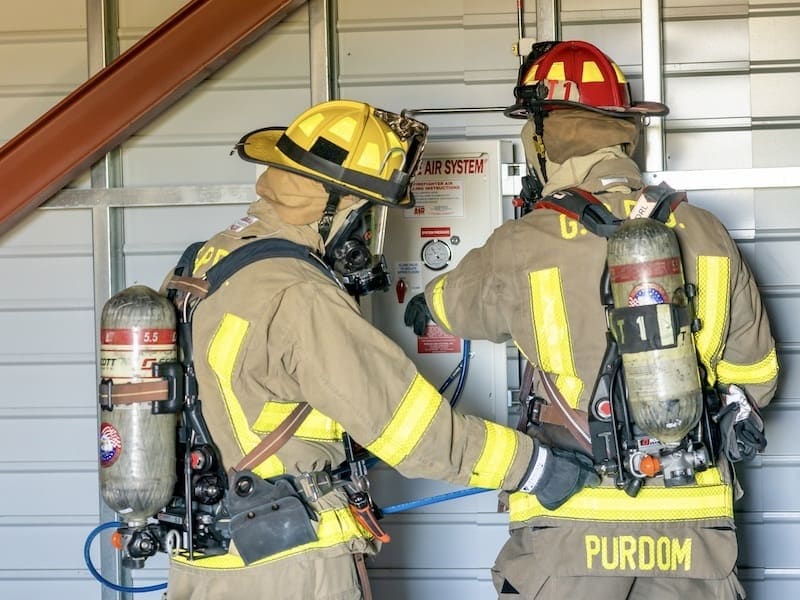
Doing the right thing in the construction world is rare when it comes to fire safety— hence, the fire code requirements and subsequent inspections and enforcement. It is also rare that the fire code would give a tool to a firefighter. Thankfully, the International Fire Code (IFC) now addresses the health and safety of firefighters through air management. The Firefighter Air Replenishment System (FARS) is simply a tool for real-world firefighters. It is not a fire prevention issue. Unfortunately, previous generations of firefighters did not have these systems, which contributed to the increase in cancers and health issues within the firefighting community, especially those who ever blew “snot rockets” out of their nose because they didn’t have access to or were not using state-of-the-art air systems. The Firefighter Air Coalition (FAC) is dedicated to and focused on firefighter air management in any situation, especially when it comes to firefighters’ safety and health. The FAC is a big supporter of FARS, dedicating technology, training, and research to firefighter air management. These systems are required by code to be monitored and tested for air quality ensuring firefighter health and safety (photo 8).
The need for a standpipe is an admission that the fire protection system has failed. If some of the hundreds of fire extinguishers required in many buildings are used, if the fire detection system operates, if the sprinkler system triggers, then why is a firefighter potentially hooking up to a standpipe? It would seem as if something failed within the fire prevention system. Any firefighter who connects to a standpipe must be able to breathe. Water systems fail or break, sprinkler systems are shut down for service and maintenance, and things simply go wrong in the fire service world—not to mention chemical spills or hazardous materials where fire prevention systems are useless but breathing becomes more important than ever to save lives and mitigate the emergency.
Thankfully, Samsung is a forward-thinking company with an eye and value on safety. In addition to state-of- the-art fire detection and fire suppression systems, the property also has standpipes and FARS. Considering that responding firefighters could easily walk hundreds of yards within one of these structures, possibly even as far as 1,000 feet, air supply could be compromised before the initial firefighters could be in place to mitigate the emergency or even possibly save lives and effect a rescue. As Kraemer stated, “There is no way we could do our job without the system” (photos 9 and 10).
The Samsung project has four distinct buildings with a FARS. The fabrication building has 26 air filling panels, the central utility building has 12 air filling panels, and the office and gas chemical storage facilities have 10 in each. These buildings all have a dedicated cascade room that is capable of filling 50 SBCA air bottles, which is more than the Taylor Fire Department presently owns. There is also a connection for a mobile air compressor system to connect and supplement the air system.
The initial price tag for the completion of this massive complex has risen to $37 billion. The Taylor Fire Department is facing future challenges that could easily come and already exist in many jurisdictions around the United States. It is imperative that forward-thinking fire chiefs and fire code officials work together to address these massive developments that local fire services are expected to respond to and mitigate, none of which can be accomplished without breathing firefighters. It is comforting that the IFC places this tool in the hands of serving and committed firefighters.
Lastly, the framework of regulations on the American fire service advocates that fire services be delivered with the health and safety of firefighters as well as the community as a focus and not an afterthought. Productive stress exists while balancing the desired level of fire service delivery and the cost associated with such a plan. While the cost of growing a department and providing the necessary resources to respond to a monster-sized structure or complex such as Samsung is unrealistic from a cost perspective, the challenges and dangers are very real. What local communities, developers, builders, and owners do today will serve as a measurement of our responsibility and promise for the future.
DANIEL E. DEYEAR
DANIEL E. DEYEAR is a deputy chief (ret.) with Dallas (TX) Fire Rescue and a more than 45-year veteran of the fire service. He previously worked for the Carrollton (TX) Fire Department and as an international fire marshal and ambassador for the American fire service for the U.S. Department of State, Foreign Building Operations. In 2013, he served on the Texas State Fire Marshal’s Line of Duty Death Task Force. He is the chairman of the TCFP Firefighter Advisory Committee and is a member of the Curriculum and Testing Committee and the Health and Wellness Committees. He is the vice president of the Dallas Firefighters Museum, a board of director for Search One, a 25-year member of the CISM team, and a Peer Support Team member. He has two associate’s degrees and a bachelor’s degree in fire protection management from Dallas Baptist University and has done postgraduate work at the University of North Texas and UT Dallas.