
Air Management Isn’t Exciting. Neither Is Running Out.
October 13, 2026
ROAM meets Know the Distance. Know your air, plan the trip out, and train like it matters.
We’d rather stretch a line, force a door, or make a search than sit through another air-management talk. Checking gauges and discussing when to leave isn’t the exciting part of the job. But getting back out is part of the job, too. If we’re serious about training for the work inside, we need to be just as serious about managing the air that gets us through it.
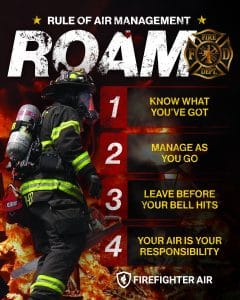
Air management belongs in those conversations, not off to the side. The air available for normal operations must support getting to the assignment, performing the work, and returning to a safe atmosphere. Managing that supply is part of accomplishing the mission, not something separate from it.
The Rule of Air Management, or ROAM, provides a straightforward foundation: know how much air you have, manage it throughout the operation, and exit the hazardous atmosphere before the low-air alarm activates. The principles are simple. Applying them requires awareness, communication, realistic training, and decisions made early enough to preserve the emergency reserve.
Know the Distance builds on that foundation. It does not replace ROAM or introduce a different rule for larger buildings. It challenges departments to understand the routes, workload, travel time, and resources involved in applying air management where their firefighters actually work.
Air management must be a training requirement
Air management is not simply a good idea left to individual preference. NFPA 1404, Standard for Fire Service Respiratory Protection Training, establishes requirements for an individual air-management program for personnel operating in immediately dangerous to life or health environments, commonly called IDLH. Its air-management provisions require exiting before consumption of the reserve supply begins and treating activation of the low-air alarm as an immediate action item for the individual and team.
That is a mandate within the standard, not a claim that the standard automatically carries the force of law in every jurisdiction. The practical point for this discussion is that air management belongs in a department’s established training program, not merely in an occasional safety reminder.
The Firefighter Air Coalition’s guidance reinforces that expectation through ongoing respiratory-protection training, written procedures, realistic drills, and practice making exit decisions under workload.
For departments, the question should move beyond whether firefighters have heard the rule. Examine how it is being practiced. Does air management appear throughout company training? Are firefighters communicating their supply? Are exit decisions part of the drill? Those questions turn a familiar subject into something the department can evaluate and improve.
Knowing your air means more than checking the gauge
Knowing your available supply before entry is essential, but knowing your air also means understanding how you consume it. Physical condition, workload, stress, and environmental conditions can affect consumption. Realistic training provides an opportunity to observe those differences and develop a practical understanding of how your supply changes under demanding conditions.
For instance, the Phoenix Fire Department’s Phoenix Regional Standard Operating Procedure, Air Management, M.P. 202.05C, shows how ROAM can be put into practice at the department level. It identifies work intensity and firefighter fitness as factors affecting working time, places responsibility on firefighters to understand their consumption, and requires company officers to remain aware of their crews’ air supply. It is a departmental example, not a national ROAM standard.
Departments can start by making air consumption, crew communication, and exit decisions part of the drills they already conduct. Bring air management into the drills already being conducted. When crews practice advancing hose, searching, or moving through a training environment, make air monitoring and communication part of the assignment. The coalition’s guidance calls for realistic scenarios, workload that challenges the air supply, and practice making exit decisions.
Keep the purpose clear. This should not become a contest to see who can stay inside longest or finish with the most air. Use the drill to understand the work, discuss consumption, and examine the decisions made along the way. The value is in what the crew learns.
Manage your air while doing the work
ROAM is not a check performed at entry and revisited when the cylinder gets low. In the Phoenix example, firefighters are responsible for monitoring and communicating their supply throughout the operation. Company officers use that information, along with exertion and distance to a safe atmosphere, to plan the crew’s exit.
The coalition’s training guidance identifies practical opportunities for air checks: after heavy workload, when changing rooms or levels, during progress reports, and before beginning a new assignment. These checks connect air awareness to the work rather than treating it as an occasional interruption.
The objective is not simply to remind firefighters to look at the gauge. It is to connect what the gauge shows to the decisions being made. A pressure reading should prompt consideration of the assignment, the crew, and the route out.
Departments can examine that connection during their drills. Are firefighters communicating air status as the work develops? Are officers using those reports to reassess the exit? Does the exercise include getting back out, or does it end when the tactical objective is reached? These questions keep the discussion focused on the entire mission.
The Phoenix procedure also illustrates command’s role in supporting air management through relief resources. It recognizes the importance of replacement crews so firefighters can leave their working positions without feeling that the assignment will stop behind them.
The alarm is not the routine signal to leave
One of ROAM’s most important distinctions is also one of its clearest: firefighters should be out of the hazardous atmosphere before the low-air alarm activates, not begin their exit when it sounds. The emergency reserve is for an emergency, not an extension of the planned work period.
That requires an exit decision based on more than remaining pressure alone. The Phoenix departmental example directs company officers to consider physical exertion, the distance required to reach a safe atmosphere, and the air pressures reported by individual firefighters. The exit plan must account for the air needed to complete the trip.
Training should reinforce that distinction. Finishing the assignment is not the only measure of a successful drill. Include the exit in the discussion and examine whether the crew made its decision early enough to preserve the reserve.
Knowing the rule is the starting point. Applying it means connecting the remaining supply to the work still ahead, including the work of leaving.
Know the route your air must support
The connection to Know the Distance begins with that trip. Knowing a building’s address, occupancy, or overall size is not the same as understanding the route firefighters will travel. The initiative’s planning framework calls for examining actual paths, including stairs, turns, obstructions, storage arrangements, and the effort required to move hose, tools, and equipment.
Distance is already part of air-management planning. The Phoenix example explicitly includes it in the officer’s exit decision and recognizes that larger buildings make exit planning more important and difficult. It also accounts for the effort required to position a handline, not merely the distance traveled.
Know the Distance asks departments to examine those demands before the incident. Walk the routes crews may use, consider the access points, and discuss the work involved. Bring those observations into preincident planning and training rather than leaving them as measurements on a worksheet.
A walk-through is a useful beginning, but it should not be treated as proof of how a crew will perform under incident conditions. Use it to identify questions for controlled training and further evaluation. The goal is not to find one distance that answers every question. It is to understand the building well enough to ask better questions about air, workload, and the mission.
Air management and supplying air are connected responsibilities
ROAM addresses the supply carried by the firefighter. Sustaining operations also requires replacement air, crew rotation, and personnel to support those functions. Know the Distance makes the distinction clear: air management and air resupply are connected, but they are not the same challenge. Managing a cylinder does not provide replacement cylinders or the staffing needed to move them.
The planning framework asks departments to evaluate the personnel required to move full cylinders forward, return empty cylinders, support cylinder exchange, and maintain resupply while preserving other critical fireground functions. The question is not simply whether bottles can be carried to a location. It is whether the department can sustain that support while continuing to staff the mission.
Make this a discussion about your own resources. Identify the support required, consider where those firefighters will come from, and examine what their commitment means for the rest of the operation. Understand the capability before crews depend on it.
Bring the discussion back to the firehouse
Air management does not need a more exciting label. It needs a place in the training and planning that firefighters already consider important. Connect it to the stretch, the search, the stairs, the assignment, and the trip out.
Start with ROAM. Reinforce air monitoring, communication, and timely exit decisions in company drills. Then use Know the Distance to examine the routes and resources in your own response area. Keep the individual, crew, and department responsibilities connected without confusing them.
Take that challenge into the station, the training ground, and the buildings you protect. Understand the supply, the workload, the route out, and the resources needed to sustain the mission. Air management may not be the most exciting part of the job, but it belongs in every conversation about doing the job and getting the crew back out.
Know your air. Know the Distance.
Resources for the station:
Air Management for the Fire Service
Know the Distance Fire Department Initiative
Table Of Contents
- Air Management Must Be A Training Requirement
- Knowing Your Air Means More Than Checking The Gauge
- Manage Your Air While Doing The Work
- The Alarm Is Not The Routine Signal To Leave
- Know The Route Your Air Must Support
- Air Management And Supplying Air Are Connected Responsibilities
- Bring The Discussion Back To The Firehouse