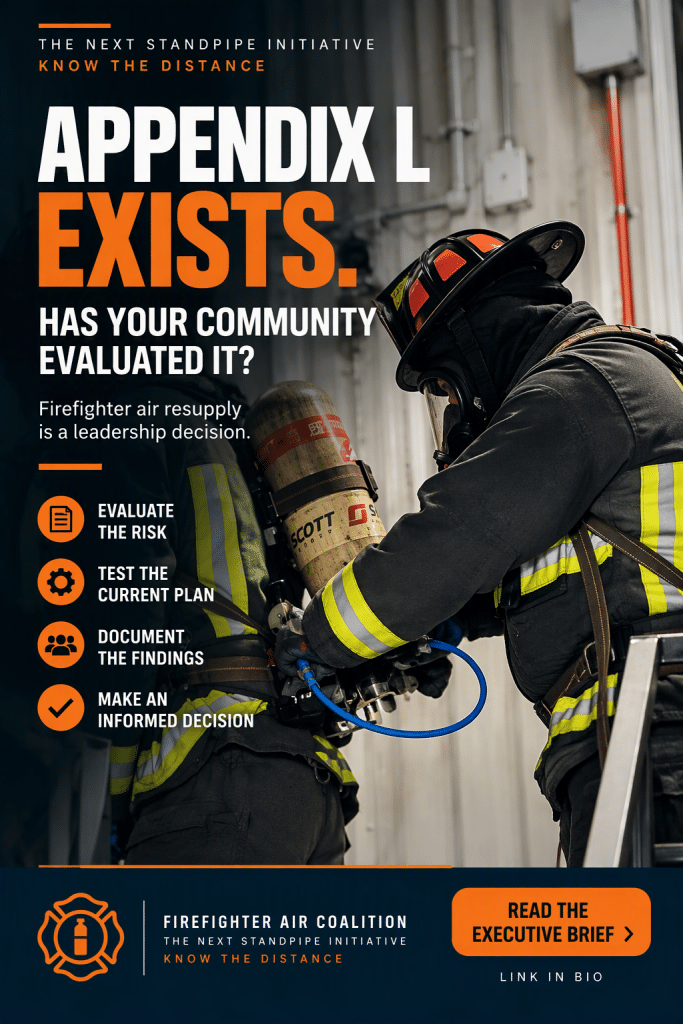
Appendix L Exists. Has Your Community Evaluated It?
October 7, 2026
Firefighter Air Replenishment Systems are established technology. The responsibility of local leadership is to determine where the operational need exists.
Fire-service leaders routinely evaluate water supply, apparatus access, staffing, mutual aid, communications, building construction, and built-in fire protection.
Firefighter breathing-air resupply deserves the same deliberate review.
Firefighters cannot conduct interior search, rescue, fire attack, overhaul, or firefighter rescue without breathing air. Yet in many large, tall, deep, and complex structures, the primary plan for replenishing that air still depends on firefighters carrying cylinders by hand.
The farther crews operate from replacement air, the more demanding that process becomes.
Bottle brigades require personnel, staging, supervision, accountability, cylinder inventory, and repeated travel between the air supply and the operating area. Every firefighter committed to moving cylinders is temporarily unavailable for another fireground assignment.
This is not simply the position of the Firefighter Air Coalition.
The International Fire Code already recognizes the operational problem.
What Appendix L Recognizes
Appendix L of the 2024 International Fire Code provides a model-code pathway for the design, installation, and maintenance of permanently installed Firefighter Air Replenishment Systems in buildings designated by the adopting jurisdiction.
Its explanatory language describes bottle brigades as an “extraordinarily firefighter-intensive process” that takes firefighters away from their primary mission of rescue and firefighting.
Appendix L also describes in-building air-supply systems with strategically located filling stations that allow firefighters to refill breathing-air cylinders inside designated buildings. The stated operational result is fewer firefighters committed to manual cylinder movement and more firefighters available for search, rescue, and fire suppression.
That local-adoption requirement makes leadership evaluation more important, not less.
The Code Does Not Make the Local Decision
Appendix L does not tell every community to reach the same conclusion.
The 2024 model-code language directs an adopting jurisdiction to establish building characteristics or special hazards that trigger a Firefighter Air Replenishment System requirement. It identifies several considerations:
Building height, floor area, construction, and fire resistance
Special hazards requiring unique air-replenishment arrangements
Fire-department staffing
Availability of a fire-department breathing-air replenishment vehicle
The department’s ability to replenish firefighter breathing air during sustained emergency operations
Those are local operational questions.
A large urban department with substantial high-rise staffing may reach a different conclusion than a combination department protecting a million-square-foot fulfillment center. A department with a nearby mobile-air unit may face different demands than one relying on mutual aid from a distant community.
The answer may differ.
The need for an honest evaluation does not.
Air Is the Price of Entry
Mike Gagliano describes breathing air as the resource that gives firefighters permission to enter a toxic, carcinogenic, and asphyxiating atmosphere.
That air must support the trip to the assignment, the work performed there, and the trip back out.
In large structures, that may mean climbing multiple flights of stairs, crossing expansive warehouse floors, or operating deep below grade. Replacement air must cover the same distance, whether firefighters travel back to it or other firefighters carry cylinders forward.
Gagliano states the Firefighter Air Coalition’s position directly: bottle brigades are not sufficient for every modern fireground, and Firefighter Air Replenishment Systems are the strongest technology currently available for delivering a replenishable air supply closer to firefighters. [Gagliano a…es-reframe | Video]
The technology exists.
The code pathway exists.
The unresolved question is local:
Where does the operational need exist?
Evaluation Is Not the Same as a Universal Mandate
Evaluating Appendix L does not require a conclusion that every commercial building needs a Firefighter Air Replenishment System.
It does require leadership to determine whether specific buildings create an air-resupply demand that the department can reasonably sustain.
That evaluation should begin with the largest, tallest, deepest, and most complex buildings in the response area.
For each building, leaders should consider:
How far firefighters must travel to reach anticipated operating areas
How much physical work is required before the primary assignment begins
Where replacement air will be staged
How full cylinders will move forward and empty cylinders will return
How many firefighters will be committed to air logistics
How long operating crews will be unavailable while changing cylinders
Whether search, fire attack, rescue, rapid intervention, accountability, and relief can remain staffed
Whether mutual-aid resources will arrive soon enough to sustain the plan
Whether cylinder and equipment compatibility has been confirmed
What resources will remain available for another emergency in the community
The objective is not simply to prove that cylinders can be moved.
The objective is to determine whether air resupply can be sustained while the department continues accomplishing the mission.
The First Responsibility Is to Ask
The absence of a local Appendix L requirement does not establish that an air-resupply problem is absent.
It may mean the issue was evaluated and the jurisdiction determined that other measures were sufficient.
It may also mean the question was never formally examined.
Those are not the same thing.
Fire chiefs, fire marshals, building officials, code officials, municipal administrators, elected officials, and risk managers should be able to answer:
Was the air-resupply risk evaluated?
Was the department’s current plan tested under realistic conditions?
Were staffing and cylinder demands calculated?
Were identified limitations documented?
Were operational and infrastructure options considered?
Was the final decision informed and recorded?
Is the conclusion reviewed when buildings, staffing, or response resources change?
Community risk reduction begins by identifying and prioritizing local risks, then making coordinated decisions about resources and mitigation. Both the National Fire Protection Association and U.S. Fire Administration describe local risk assessment as the foundation for intentional community risk reduction. Review NFPA’s community-risk guidance and U.S. Fire Administration resources. [nfpa.org], [usfa.fema.gov]
Appendix L belongs in that evaluation wherever building conditions and fire-department capability raise a legitimate breathing-air resupply concern.
What Happens After the Risk Is Identified?
A fire department may identify an operational gap without having the legal authority or financial resources to resolve it alone.
That is when the discussion must move beyond the firehouse.
Once the department documents that a building may exceed its ability to sustain air resupply through conventional methods, municipal leadership must decide what happens next.
No single response will fit every building or community.
But a clearly documented risk deserves a clearly documented decision.
The Next Question
This article is not legal advice, and no single code provision determines municipal liability. Governmental-immunity rules, discretionary-function protections, code-adoption laws, causation, and other legal issues vary substantially by state and by circumstance.
The immediate issue is more basic than a legal conclusion.
It is leadership accountability.
When an operational concern is recognized in the model code, the technology exists, and local conditions can be measured, community leaders should know whether the issue was evaluated.
Choosing not to adopt Appendix L after a documented review is one decision.
Never evaluating the problem Appendix L was created to address is another.
Has your community evaluated Appendix L for its firefighters?
Identify the buildings.
Walk the operating routes.
Test the current air-resupply plan.
Determine the staffing commitment.
Document the findings.
Then decide whether Appendix L belongs in the community’s plan for protecting firefighters.
Because once the risk is known, the next question becomes unavoidable:
What did the community do with that knowledge?
Read the Know the Distance Executive Brief. Evaluate the need. Start the local discussion.