
The Next Standpipe | Know the Distance
September 23, 2026
Firefighters need two resources to work inside a building: water and air.
For generations, the fire service improved how water reached firefighters. Hydrants, fire pumps, standpipes, and sprinkler systems all recognize the same reality. At some point, building height, depth, size, or complexity can exceed what firefighters can reasonably support from the street. When that happened, the building began helping deliver the resource.
Air has not followed the same path.
That simple observation is what drives The Next Standpipe Initiative | Know the Distance.
The Buildings Have Changed
Consider a truck company climbing 20 flights of stairs to reach a high-rise fire. Now consider an engine company advancing a hoseline hundreds of feet into a 650,000-square-foot big-box store or a search team operating deep inside a multilevel fulfillment center. The buildings are different, but the firefighter is the same. The firefighter is still carrying the same cylinder, still managing the same air supply, and still expected to search, rescue, control the fire, protect exposures, and help fellow firefighters when conditions deteriorate.
What has changed is the environment in which that work must now be performed.
As buildings continue to grow larger, taller, deeper, and more complex, firefighters experience that growth as distance. Longer travel distances, larger search areas, remote operating locations, and greater separation from replacement air all place new demands on the fireground. The farther firefighters must travel to reach the assignment, and the farther they must travel to reach replacement air, the greater the manpower, time, and operational commitment required to sustain the mission.
Distance Creates Work
Distance does more than separate firefighters from replacement air.
A truck company climbing 20 flights of stairs to reach a high-rise fire is performing significant physical work before reaching the fire floor. An engine company advancing charged hoselines hundreds of feet into a warehouse, fulfillment center, or big-box occupancy is performing significant physical work before water is flowing on the fire. In both cases, the assignment begins long before the actual assignment begins.
Firefighter physiology research cited by the UL Fire Safety Research Institute demonstrates that demanding fireground tasks increase breathing rates, cardiovascular strain, fatigue, and air consumption. As firefighters climb stairwells, advance hoselines, conduct searches, and perform other labor-intensive tasks, a greater portion of their available air supply may be consumed before the primary assignment even begins. Research also suggests that as fatigue increases, firefighters may be capable of less work while continuing to experience significant physiological strain. The supporting research is summarized in the Executive Brief and accompanying Firefighter Air resources.
For departments, the implication is straightforward. Distance is not simply a travel problem. Distance creates work. Increased work increases air consumption. Increased air consumption can reduce available working time and increase the demand for air resupply, crew rotation, rehabilitation, and logistical support.
As buildings continue to grow, the physical effort required to reach the assignment becomes part of the air-resupply challenge itself.
The Capacity Question
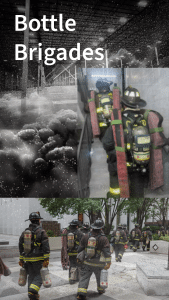
The question is not whether firefighters can move air.
The question is whether departments can continue moving enough air, far enough, and for long enough while still accomplishing every other critical fireground function. Every department should be asking how many firefighters are required to sustain air resupply, what assignments are affected when those firefighters are committed to moving cylinders, how much time is consumed cycling crews to replacement air, and at what point the demand for air begins competing with the resources needed for search, rescue, fire attack, rapid intervention, accountability, and crew relief.
Those are not questions that should first be answered during an emergency.
At some point, departments protecting today’s large-footprint buildings, mega-warehouses, fulfillment centers, and high-rise occupancies may discover that the manpower needed to sustain air resupply is beginning to compete with the manpower needed to complete the mission. Understanding whether that point exists, and where it exists, is one of the reasons this conversation needs to happen now.
Why We Created the Next Standpipe Initiative
The purpose of The Next Standpipe Initiative | Know the Distance is not to promote a product, endorse a manufacturer, or advocate for a predetermined solution. It is to encourage departments to examine their own buildings, evaluate their own capabilities, and better understand the manpower, time, and operational commitment required to sustain air resupply before the fireground exposes a limitation.
The conversation begins with a simple idea:
Know the Distance
Every department can start today by examining three basic questions.
Measure It. Walk the route between the point of operation and reliable breathing air. Understand the actual distance firefighters must travel, not the distance shown on a site plan.
Staff It. Determine how many firefighters are required to sustain air resupply while still maintaining search, fire attack, rescue, rapid intervention, accountability, and crew relief.
Plan For It. Understand what that commitment means for the incident, for mutual aid, and for the rest of the community that still depends on a fire department capable of answering the next call.
Firefighter Air has developed the Know Your Distance Fire Department Planning Guide, with an assessment tool, to help your department answer these questions.
Before the fire service can answer This or That? – it first must know the distance.
This or That?
At the center of The Next Standpipe Initiative is a simple question.
This: Continue relying on firefighters to carry breathing air to the point of operation.
That: Explore ways to bring reliable breathing air closer to where firefighters need it.
The purpose of the initiative is not to prescribe the answer. The purpose is to understand the problem. Only after departments understand the distance, manpower, time, and operational consequences involved can they determine whether current air-resupply practices remain sufficient or whether the conversation should move from This to That.
The Mission Has Not Changed
Firefighters still enter buildings for the same reasons they always have: to search for victims, rescue occupants, extinguish the fire, perform overhaul, protect life, protect property, and help one another when things go wrong. Every one of those responsibilities depends on breathing air.
The mission has not changed. The oath has not changed. The buildings have.
The Next Standpipe Initiative exists to ensure the fire service examines what that change means before the fireground forces the answer.
Know the Distance.
Know the Demand.
Measure It.
Staff It. Plan for It.
Resources:
Know the Distance Fire Department Air Resupply Planning Guide
Know the Distance: Firefighter Air Resupply Assessment Worksheet
Big-Box Fire Response Planning Guide
High-Rise: Equipment Deployment Plan
Improving High-Rise Operations: Lessons Learned from Duke City